
01CHANT (Celestial High-rate Attitude & Navigation Tracker)
Star trackers that keep working when satellites turn fast.
CHANT is a star tracker for satellite builders and operators. It keeps working during fast turns, and spots other objects in orbit with the same camera.
02See the difference
Same turn. Same camera.
Watch what happens as the turn speeds up.


CHANT reads attitude directly from blurred star images. It's designed to run on off-the-shelf hardware, at power comparable to a standard star tracker.
- Software-tested on simulated data
- Hardware prototype next
- Built in Canada
03The problem
Fast turns blind today's star trackers.
Every satellite needs to know exactly where it's pointing. Most use a star tracker, a small camera that reads the stars. Above a few degrees per second, stars smear into streaks, the tracker loses its fix, and the satellite relies on less accurate sensors until it slows down.
- 01
Earth-observation satellites turn quickly between targets to capture more images per orbit.
- 02
Surveillance satellites turn quickly to follow objects.
Every second without an accurate fix is lost imaging time or added risk.
As orbit gets more crowded and more contested, knowing where you're pointing and what's around you stops being optional.
Today
Two separate problems, two separate fixes. Satellites handle fast turns by slowing down, adding sensors, or correcting their pointing after the fact. Objects in orbit are tracked from the ground, or by launching dedicated satellites built for nothing else.
With CHANT
Designed to do both, from a device satellites already carry. One sensor. No extra payload. No dedicated constellation.
04Second capability
One sensor. Two jobs.
The same camera also sees other satellites and debris as moving points of light. CHANT is designed to pick them out during normal operation and report where they are. That gives operators and defence agencies a new source of data on what's in orbit.
- 01
Pointing during fast turns
- 02
Spotting objects in orbit
In development

05Users
Who it's for
-
Earth-observation operators
More targets per pass.
A satellite turning between two imaging targets keeps its fix the whole way, instead of waiting to settle.
-
Defence and space surveillance
Awareness from every satellite, not only dedicated ones.
Satellites flying CHANT for their own missions also report objects they see.
-
Satellite builders
A tracker that handles agile missions.
One sensor covers pointing during fast turns and spotting objects, with no extra payload.
06How it works
Want the detail?
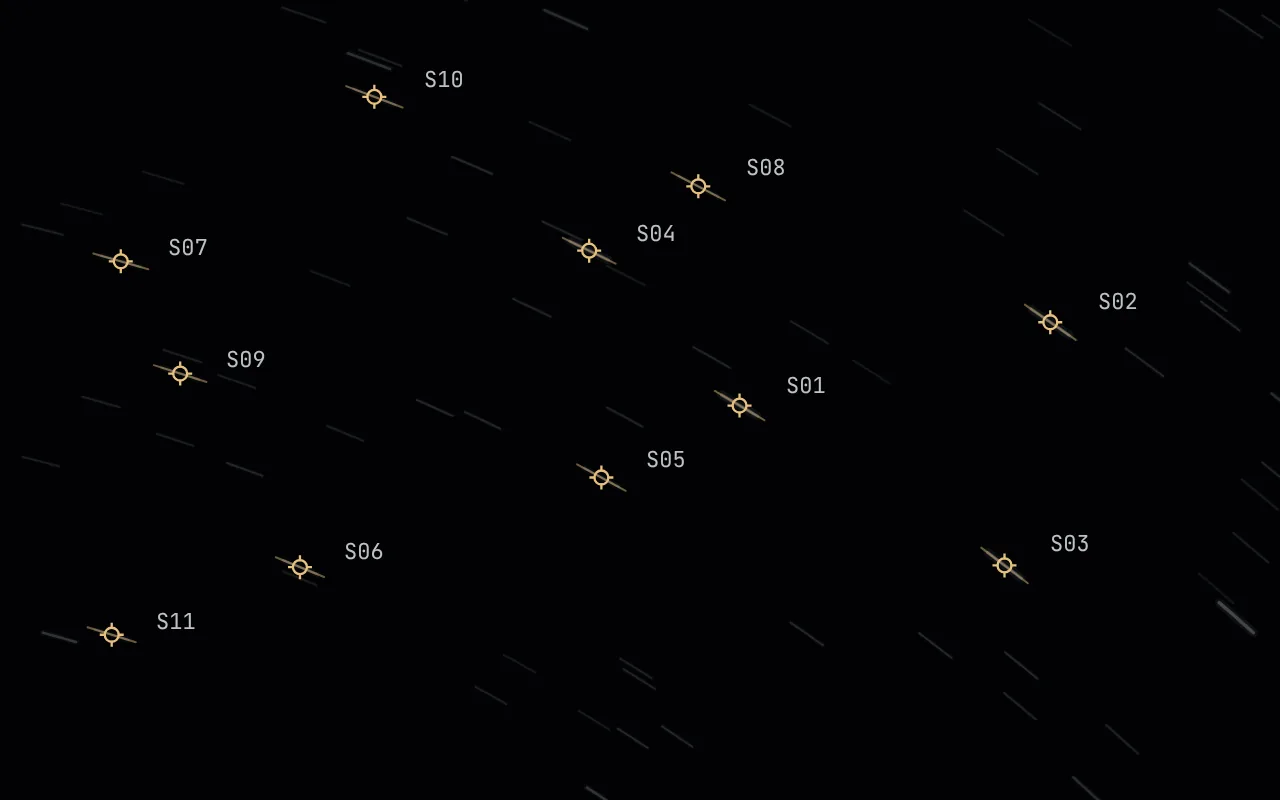
See how CHANT finds stars in blurred images, the results so far, and what we haven't confirmed yet.
How it works →Built to give every satellite both.
Pointing during fast turns. Awareness of what's around it.

07Contact
Ready for your mission?
We're talking to satellite teams about fast maneuvers. If your satellites turn faster than their star trackers can follow, we'd like to hear how you handle it today.