01Overview
How CHANT works
CHANT (Celestial High-rate Attitude & Navigation Tracker) is attitude determination software that works directly from streaked star images. Conventional trackers need stars to be sharp points, so they lose their solution during high-rate slews. CHANT detects the streaks, fits them, recovers star centers and matches them against a star catalog, so attitude stays available while the spacecraft turns. The same frames are designed to also reveal objects moving against the star field (in development).
Software testing, simulated data
02The problem
Why conventional trackers fail at high rates
A star tracker images the sky, finds star centroids, identifies them against a catalog and solves for attitude. All of that assumes stars are points. Above a few degrees per second, they aren't. The tracker drops its solution and the ADCS falls back on gyro propagation, with drift growing until the spacecraft slows down and the tracker re-acquires. Commercial trackers are typically rated for a few degrees per second; some high-end units are rated up to about 8°/s.
Motion blur
During an exposure the boresight keeps moving, so each star smears into a streak of length rate × exposure. At 20°/s and 67 ms that is about 1.3°. Point-source centroiding no longer applies.
Loss of star ID
Identification needs enough stars with accurate positions. With fewer stars and distorted centroids, pattern matching fails and the tracker reports no fix.

03Method
One frame, five steps
The frame is frozen at 18.9°/s with a 67 ms exposure, the same conditions as the evidence images below. Step through it, or let it play.

Raw frame: a 67 ms exposure taken while the spacecraft turns at 18.9°/s. Every star is a streak.
Pattern lines are illustrative.
04Results
Performance so far
Everything below comes from software testing on simulated data. We have no hardware or flight results yet. Accuracy figures are shared on request.
| What | Rate | How | Status |
|---|---|---|---|
| Attitude fix on streaked star images | up to 20°/s | CHANT software on simulated star-field frames | Software testing Fix held |
| Streak detection on a noisy frame | 18.9°/s, 67 ms | Simulated exposure with sensor noise and bright-scene interference, run through the detector (see results note; images in 07 Evidence) | Software testing |
| Attitude and rate accuracy, sustained slews | 2.5, 5 and 20°/s | Simulation | Available on request |
| Object detection and artifact rejection | Not yet characterized | Simulated frames (see results note) | In development |
Streak detection and object detection results shown here come from an earlier neural network version of the detector; we're moving both into a faster pipeline.
Accuracy figures are shared after a short call.
05Architecture
Onboard processing
CHANT is designed to run its processing on the satellite, on a dedicated accelerator, so raw images stay onboard and downlink bandwidth is saved for the data that matters.
It's designed to run on off-the-shelf hardware at a size and power similar to a standard star tracker. A hardware prototype is next.
06Second job
Object detection In development
Stars move together with the camera, so during a slew their streaks share one flow across the frame. Another satellite or a piece of debris has its own motion on top of that, so it moves against the star flow. A sensor artifact, such as a cosmic ray hit, stays fixed on the detector and lasts only briefly.
CHANT is designed to use those differences to flag objects and discard artifacts, from the same frames it uses for attitude, with no extra payload. An earlier version of the detector did this on simulated frames (see results note). We're now building it into a faster pipeline.

- Object detected
- Discarded: sensor noise
- Star measurement
07Evidence
One instant, three views
Real outputs from our simulator and detector (see results note), not illustrations. All three show the same moment of a simulated slew.
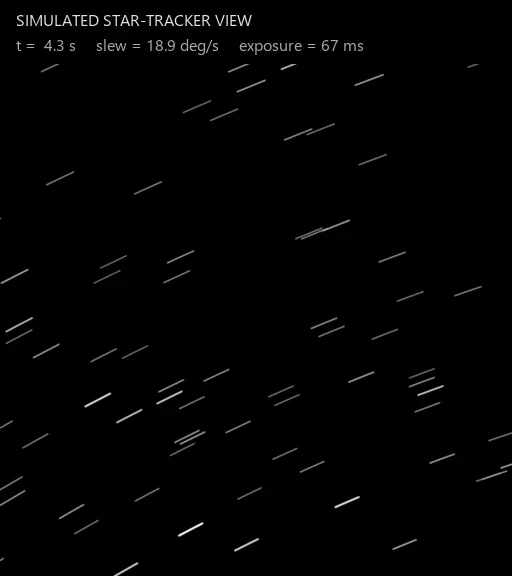
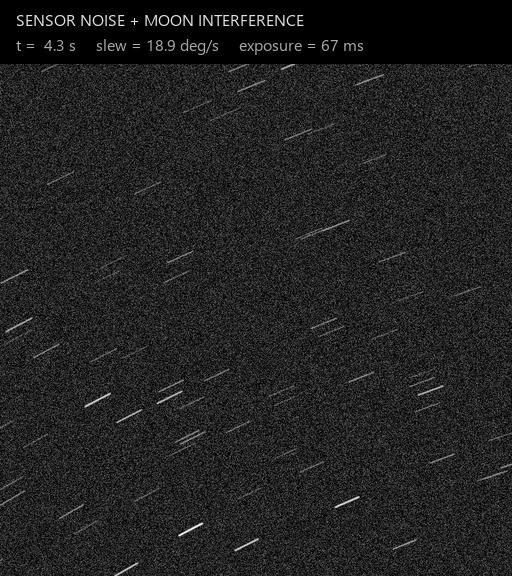
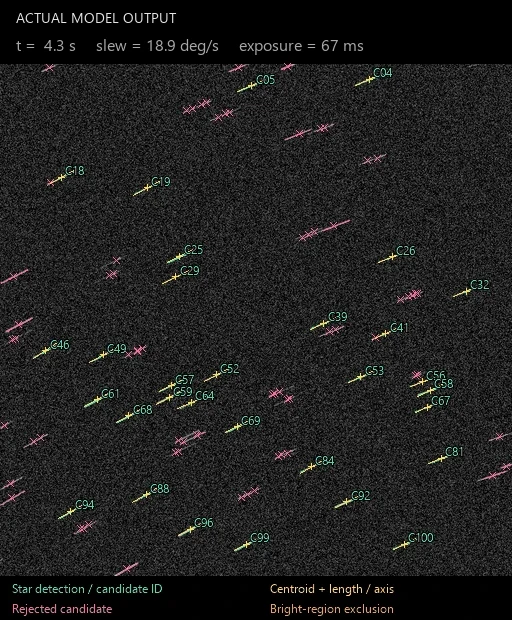
The simulated exposure: streaked stars at the selected test time, before any noise is added.
Parameters: t = 4.3 s into the slew, 18.9°/s, 67 ms exposure.
08Status
Status and next steps
Simulated
The test environment
- Star-field exposures during slews up to 20°/s
- Sensor noise and bright-scene interference
Software-tested
CHANT on simulated data
- Attitude fix held on streaked frames up to 20°/s, in software testing
- Streak detection with accepted and rejected candidates on a noisy frame at 18.9°/s (see results note)
Next
From software to orbit
- Object detection in the faster pipeline
- Hardware prototype
- Flight

09Contact
Talk to us about your ADCS requirements
If your mission needs attitude knowledge during high-rate slews, we'd like to understand your rates, exposure times and accuracy needs.